The Recipes That Almost Disappeared — And the Families Bringing Them Back
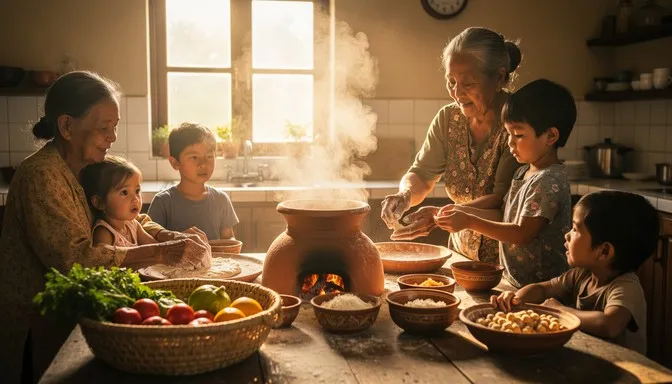
Photo: multigenerational family cooking traditional fermented foods cultural kitchen heritage, via images.stockcake.com
Something Was Lost. Something Is Coming Back.
Somewhere between the postwar rush toward convenience food and the rise of the supermarket, a lot of American families quietly stopped fermenting. The crocks got pushed to the back of the pantry. The recipes stayed in someone's head and never made it to paper. The knowledge — built over generations, carried across oceans — just sort of... faded.
But here's the thing about fermentation traditions: they're stubborn. And so are the people who grew up smelling kimchi in their grandmother's kitchen, or watching their abuela strain pineapple rinds through a cloth for tepache, or hearing stories about the crock of sauerkraut that sat in a Polish great-grandmother's cellar every winter without fail.
Across the United States right now, a genuine revival is underway. It's happening on kitchen counters in Atlanta and Seattle and Chicago and small towns in between. Third and fourth-generation Americans are reclaiming fermentation practices that nearly vanished from their family lines — and in doing so, they're reconnecting with something that goes way deeper than food.
Kimchi as Memory
Soo-Jin Park grew up in suburban New Jersey, the granddaughter of Korean immigrants who ran a small grocery store in Palisades Park. Her grandmother, whom the family called Halmoni, made kimchi twice a year — big batches that filled the apartment with a smell Soo-Jin remembers as equal parts pungent and comforting.
"When Halmoni passed, nobody in our family knew how to make it," says Soo-Jin, now 38. "We just bought it from the store. But it never tasted the same. I think I spent ten years not realizing how much I missed it."
The pandemic changed that. With time on her hands and a sudden hunger for connection, Soo-Jin called her mother's older sister — still living in Seoul — and asked her to walk her through the family recipe over video call. What followed was a three-hour session involving a lot of hand gestures, imperfect translation, and laughter.
"My aunt kept saying 'just enough' when I asked about measurements. That's how traditional recipes work — you feel it, you don't measure it. Learning that was part of learning the recipe."
Soo-Jin now makes kimchi four times a year. She's adapted it slightly — she uses locally grown napa cabbage from a New Jersey farm and adjusts the gochugaru level for her kids — but the foundation is her Halmoni's. She's written it down. It won't disappear again.
Eastern European Roots, American Kitchens
The fermentation traditions of Eastern Europe — Poland, Ukraine, Hungary, the Czech Republic — were built for survival. Long winters, root cellars, and the need to preserve summer's harvest made fermenters out of everyone. Beet kvass, fermented pickles, sauerkraut, kefir: these weren't health foods. They were just food.
For families like the Kowalski-Brennans of Minneapolis, that tradition got diluted over generations. "My great-grandparents came from Poland in the 1920s," says Tom Kowalski-Brennan, a 45-year-old high school history teacher. "By the time my parents were growing up, the only fermented thing in the house was store-bought pickle relish on hot dogs."
Tom started fermenting about five years ago, initially for health reasons after a bout with digestive issues. But it quickly became something more personal. He started researching traditional Polish fermentation, connected with a Polish cultural organization in his city, and eventually learned to make żurek — a sour rye soup built on a fermented rye starter — from a woman whose family had been making it for four generations.
"There's a word in Polish, tęsknota, that roughly means a deep longing for something or someone," he says. "When I eat żurek, I feel that. It's grief and joy at the same time. It's a connection to people I never met but who shaped who I am."
Tepache and the Mexican Fermentation Tradition
In San Antonio, Marisol Fuentes-Garza is doing something her neighbors find slightly baffling: she ferments pineapple rinds on her kitchen counter every week. The result is tepache — a lightly fermented, mildly fizzy drink with pre-Hispanic roots that's been made in Mexico for centuries.
"My grandmother made it every summer," Marisol says. "She'd save the rind from every pineapple we ate, add piloncillo and a cinnamon stick, and let it sit for a couple of days. We'd drink it ice cold. I thought everybody's grandmother did this."
They didn't. And when Marisol moved out on her own, she realized she'd taken the knowledge for granted. It took a trip back to her grandmother's house in Oaxaca and a patient afternoon in the kitchen to get the recipe right again.
Now Marisol shares it — on social media, at neighborhood gatherings, in a Spanish-language fermentation workshop she runs quarterly at a local community center. "Fermentation is a form of food sovereignty," she says. "When we know how to make our own food, we're less dependent on systems that don't always serve our communities. That feels political to me. And it feels like love."
Japanese Fermentation: Patience as Practice
The Japanese fermentation tradition is arguably one of the most sophisticated in the world — miso, sake, soy sauce, tsukemono, natto — and it's built on a philosophy of patience that doesn't always translate easily to American life.
Kenji Murakami-Hall, a 29-year-old chef in Portland, Oregon, has spent the last three years learning to make miso from scratch. His Japanese-American grandfather made it. His father didn't. Kenji is determined to close that gap.
"Miso takes months," he says. "Sometimes a year. In a culture that wants everything instantly, committing to a ferment you won't taste until next fall is almost a radical act."
He's not wrong. And that's exactly why it matters. The act of fermenting — of putting something up and waiting for it — is itself a form of cultural memory. It requires the same trust in time and process that generations before us practiced as a matter of course.
How to Start Honoring Your Own Heritage
You don't need a grandmother on speed dial or a trip overseas to begin. Here's where home fermenters can start:
- Research your ancestry. Nearly every food culture has a fermentation tradition. Look up what your ancestral regions were making before industrialization changed everything.
- Find community. Cultural organizations, heritage groups, and online fermentation communities are full of people who've already done this work and want to share it.
- Start simple. Tepache, water kefir, and basic vegetable lacto-ferments are forgiving entry points that build confidence fast.
- Document everything. Write down what you learn. Record the video calls. Take the photos. Don't let the knowledge slip away again.
- Adapt without guilt. Your great-grandmother's recipe was already an adaptation of her great-grandmother's. Food is living history — it's supposed to evolve.
At Hale Fermented, we believe that fermentation is one of humanity's oldest and most democratic food technologies. It belongs to everyone. And the best version of it is the one that carries your family's story forward — alive, rooted, and full of flavor.