Salt, Time, and Memory: How Immigrant Fermentation Traditions Are Quietly Rewriting American Food

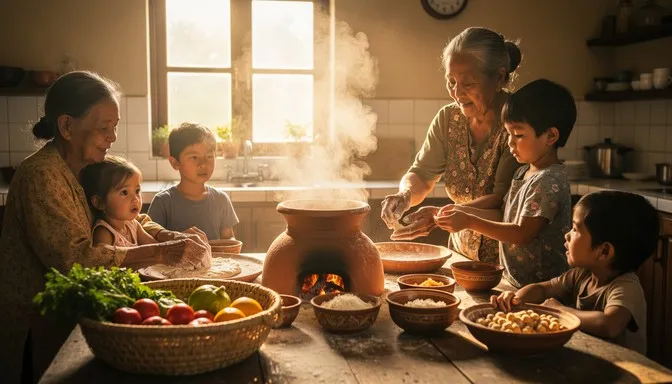
Photo: diverse immigrant families making fermented foods kimchi sauerkraut cultural kitchen tradition, via i.redd.it
There's a particular kind of knowledge that doesn't travel well in suitcases. You can't fold it up and tuck it between your clothes. It lives in hands — in the way a person knows, without measuring, exactly how much salt a batch of vegetables needs. In the feel of a ferment that's ready versus one that needs another day. In the smell of a crock that's working the way it should.
This is the knowledge that immigrant families have been carrying into the United States for generations, and right now, it's having a moment. Fermented foods from Korean, Eastern European, Latin American, and Southeast Asian culinary traditions are no longer niche curiosities tucked into specialty grocery stores. They're reshaping American food culture from the inside out — appearing on restaurant menus, in farmers market stalls, and increasingly in the home kitchens of people who didn't grow up with them.
The story of how that happened is really a story about people. Specific people, specific kitchens, specific jars.
The Crock That Crossed the Ocean
In Flushing, Queens — one of the most ethnically diverse neighborhoods in the United States — Korean-owned grocery stores have long stocked the ingredients for traditional kimchi: napa cabbage, gochugaru, saeujeot (salted shrimp), and the particular variety of garlic that ferments differently than the kind you'd find at a standard American supermarket.
For decades, those ingredients were purchased almost exclusively by Korean families maintaining a practice that stretches back centuries. Kimchi isn't just a condiment in Korean culinary tradition — it's a preservation system, a nutritional cornerstone, and a deeply social ritual. The practice of kimjang, the communal autumn kimchi-making that feeds families through winter, was recognized by UNESCO as an Intangible Cultural Heritage in 2013.
But something shifted. Younger Korean Americans, many of them born in the US, started talking about kimchi differently — not just as a family staple but as something worth sharing, explaining, and yes, selling. Food writers and chefs began paying attention. And gradually, the crock that had always lived in the back of the kitchen started moving toward the center of the American food conversation.
Chefs like Roy Choi brought kimchi into mainstream American consciousness through his LA-based Kogi food trucks, putting kimchi quesadillas and Korean short rib tacos in front of people who'd never set foot in a Korean restaurant. That crossover moment didn't erase the tradition — it amplified it, sending curious eaters back to the source.
Curtido, Kvass, and the Living Foods of the Diaspora
Kimchi gets most of the press, but the fermentation traditions arriving in American cities are far more varied than a single dish.
In Houston's large Salvadoran community, curtido — a lightly fermented cabbage slaw seasoned with oregano and vinegar — has been a fixture on family tables for generations. It's the traditional accompaniment to pupusas, and in neighborhoods like the East End, you can find it made fresh at taquerías that have been operating for decades. What's changed recently is that younger Salvadoran American food entrepreneurs are starting to bottle and sell it, framing it explicitly as a probiotic food for health-conscious consumers who might never have tried a pupusa.
In Chicago, the Polish and Ukrainian communities of neighborhoods like Ukrainian Village have kept alive a tradition of fermented foods that includes beet kvass, sauerkraut, and fermented pickles made with dill and garlic rather than vinegar. These aren't artisanal affectations — they're practical preservation techniques that families have used for generations. But they're now being discovered by a broader audience through community markets and pop-up events that bridge cultural worlds.
In the Vietnamese communities of San Jose and Houston, fermented shrimp paste, fish sauce, and dưa cải (fermented mustard greens) anchor home cooking in ways that rarely make it onto mainstream food media's radar. These are complex, deeply savory ferments that take real skill to make well — and the knowledge of how to make them is being actively preserved by community organizations and food educators who understand what's at stake if it's lost.
What the Next Generation Is Doing With the Recipe
Here's where things get genuinely exciting. Across the country, the children and grandchildren of immigrant fermenters are doing something fascinating: they're honoring the tradition while refusing to be frozen by it.
Mia Nguyen, a second-generation Vietnamese American food blogger based in Portland, Oregon, has spent the last three years documenting her grandmother's fermentation techniques while also experimenting with adaptations — using locally grown Oregon vegetables in traditional Vietnamese ferments, or adjusting salt levels for American palates that aren't accustomed to the intensity of traditional recipes. "I'm not trying to make it less Vietnamese," she's said. "I'm trying to make it something my grandmother and my neighbors can both love."
That tension between preservation and adaptation is real, and it's not always comfortable. Some community elders worry that Americanized versions of traditional ferments flatten the complexity of the original. Others see adaptation as the natural evolution of a living food culture — the same process that has always allowed culinary traditions to survive migration and change.
What's clear is that the conversation is happening, loudly and productively, in communities across the country. And the fermented foods themselves are at the center of it.
Why This Matters Beyond the Plate
Food culture isn't separate from culture — it is culture. The way communities feed themselves encodes values, histories, seasonal rhythms, and relationships that can't be captured in a recipe card.
When a Korean American family makes kimchi together in November, they're participating in something that connects them to ancestors they never met. When a Guatemalan grandmother teaches her granddaughter to make tepache from pineapple rinds and piloncillo, she's transmitting knowledge that pharmaceutical companies now spend millions trying to replicate in probiotic supplements.
The fermentation traditions being practiced in immigrant communities across America aren't just interesting food stories. They're archives. They're evidence that humans have always understood, intuitively, that living foods support living bodies — long before we had the science to explain the microbiome.
At Hale Fermented, we believe that being alive with flavor and rooted in tradition isn't just a brand statement — it's a description of what fermented food actually is. And the communities keeping those traditions alive in American kitchens, storefronts, and farmers markets are doing something genuinely important.
The least we can do is pay attention. Better yet: show up hungry.